avatar

bellesbooks

the oxford comma is non-negotiable

839 points

0% overlap
Justice for All
Made for the Movies
Iconic Series
My Taste
The Jakarta Method: Washington's Anticommunist Crusade and the Mass Murder Program that Shaped Our World
The Paper Menagerie and Other Stories
Kitchen Confidential: Adventures in the Culinary Underbelly
Reading...
The Correspondent
65%
The Wall of Storms
49%
How to Hide an Empire: A History of the Greater United States
8%
avatar

bellesbooks commented...

1d

  • Thoughts from 30% - ch16
    4
    1
  • Everything Is Tuberculosis: The History and Persistence of Our Deadliest Infection
    avatar
    bellesbooks reviewed...
    Sep 15, 2026
    Everything Is Tuberculosis: The History and Persistence of Our Deadliest InfectionJohn Green
    5.0
    Enjoyment: Quality: Characters: Plot:
    1
  • avatar

    bellesbooks is interested in reading...

    2d

    Kill Anything That Moves: The Real American War in Vietnam (American Empire Project)

    Kill Anything That Moves: The Real American War in Vietnam (American Empire Project)

    Nick Turse

    Based on classified documents and first-person interviews, a startling history of the American war on Vietnamese civilians Americans have long been taught that events such as the notorious My Lai massacre were isolated incidents in the Vietnam War, carried out by “a few bad apples.” But as award-winning journalist and historian Nick Turse demonstrates in this groundbreaking investigation, violence against Vietnamese noncombatants was not at all exceptional during the conflict. Rather, it was pervasive and systematic, the predictable consequence of orders to “kill anything that moves.” Drawing on more than a decade of research in secret Pentagon files and extensive interviews with American veterans and Vietnamese survivors, Turse reveals for the first time how official policies resulted in millions of innocent civilians killed and wounded. In shocking detail, he lays out the workings of a military machine that made crimes in almost every major American unit all but inevitable. Kill Anything That Moves takes us from archives filled with Washington’s long-suppressed war crimes investigations to the rural Vietnamese hamlets that bore the brunt of the war; from boot camps where young American soldiers learned to hate all Vietnamese to bloodthirsty campaigns like Operation Speedy Express, in which a general obsessed with body counts led soldiers to commit what one participant called “a My Lai a month.” Thousands of Vietnam books later, Kill Anything That Moves, devastating and definitive, finally brings us face-to-face with the truth of a war that haunts Americans to this day.

    0
    avatar

    bellesbooks is interested in reading...

    2d

    The Divide: A Brief Guide to Global Inequality and its Solutions

    The Divide: A Brief Guide to Global Inequality and its Solutions

    Jason Hickel

    For decades we have been told a story about the divide between rich countries and poor countries. We have been told that development is working: that the global South is catching up to the North, that poverty has been cut in half over the past thirty years, and will be eradicated by 2030. It’s a comforting tale, and one that is endorsed by the world’s most powerful governments and corporations. But is it true? Since 1960, the income gap between the North and South has roughly tripled in size. Today 4.3 billion people, 60 per cent of the world's population, live on less than $5 per day. Some 1 billion live on less than $1 a day. The richest eight people now control the same amount of wealth as the poorest half of the world combined. What is causing this growing divide? We are told that poverty is a natural phenomenon that can be fixed with aid. But in reality it is a political problem: poverty doesn’t just exist, it has been created. Poor countries are poor because they are integrated into the global economic system on unequal terms. Aid only works to hide the deep patterns of wealth extraction that cause poverty and inequality in the first place: rigged trade deals, tax evasion, land grabs and the costs associated with climate change. The Divide tracks the evolution of this system, from the expeditions of Christopher Columbus in the 1490s to the international debt regime, which has allowed a handful of rich countries to effectively control economic policies in the rest of the world. Because poverty is a political problem, it requires political solutions. The Divide offers a range of revelatory answers, but also explains that something much more radical is needed – a revolution in our way of thinking. Drawing on pioneering research, detailed analysis and years of first-hand experience, The Divide is a provocative, urgent and ultimately uplifting account of how the world works, and how it can change.

    0
    avatar

    bellesbooks started reading...

    2d

    How to Hide an Empire: A History of the Greater United States

    How to Hide an Empire: A History of the Greater United States

    Daniel Immerwahr

    A pathbreaking history of the United States' overseas possessions and the true meaning of its empire We are familiar with maps that outline all fifty states. And we are also familiar with the idea that the United States is an "empire," exercising power around the world. But what about the actual territories--the islands, atolls, and archipelagos--this country has governed and inhabited? In How to Hide an Empire, Daniel Immerwahr tells the fascinating story of the United States outside the United States. In crackling, fast-paced prose, he reveals forgotten episodes that cast American history in a new light. We travel to the Guano Islands, where prospectors collected one of the nineteenth century's most valuable commodities, and the Philippines, site of the most destructive event on U.S. soil. In Puerto Rico, Immerwahr shows how U.S. doctors conducted grisly experiments they would never have conducted on the mainland and charts the emergence of independence fighters who would shoot up the U.S. Congress. In the years after World War II, Immerwahr notes, the United States moved away from colonialism. Instead, it put innovations in electronics, transportation, and culture to use, devising a new sort of influence that did not require the control of space. Rich with absorbing vignettes, full of surprises, and driven by an original conception of what empire and globalization mean today, How to Hide an Empire is a major and compulsively readable work of history.

    0
    avatar

    bellesbooks commented...

    3d

    you're gonna catch up to me at this rate

    avatar

    bellesbooks commented...

    3d

    yay!!!

    avatar

    whatninireads started reading...

    4d

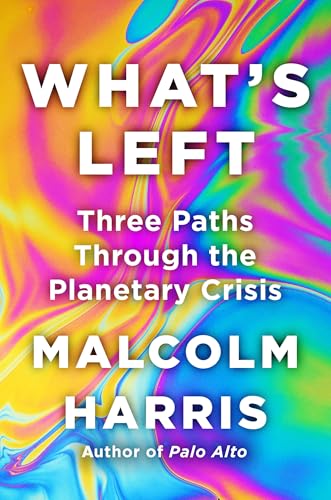
    What's Left: Three Paths Through the Planetary Crisis

    What's Left: Three Paths Through the Planetary Crisis

    Malcolm Harris

    A vital guide for collective political action against the climate apocalypse, from bestselling leftist Malcolm Harris— “a brilliant thinker and writer capable of making the intricacies of economic conditions supremely readable” (Vulture). Climate change is the unifying crisis of our time. But the scale of the problem can be paralyzing, especially when corporations are actively staving off changes that could save the planet but which might threaten their bottom lines. To quote Greta Thunberg, despite very clear science and very real devastation, the adults at the table are still saying “blah blah blah.” Something has to change—but what, and how? In What's Left, acclaimed writer and public intellectual Malcolm Harris cuts through the noise and gets real about our remaining options for saving the world. Just as humans have caused climate change, we hold the power to avert a climate apocalypse, but that will only happen through collective political action. Harris outlines the three strategies—progressive, socialist, and revolutionary—that have any chance of succeeding, while also revealing that none of them can succeed on their own. What's Left shows how we must combine them into a single a meta-strategy, one that will ensure we can move forward together rather than squabbling over potential solutions while the world burns. Vital and transformative, What's Left is the guidebook we need at the moment we need it most. It confirms Malcolm Harris as next-generation David Graeber or Mike Davis—a historian-activist who shows us where we stand and how we got here, while also blazing a path toward a brighter future.

    1
    avatar

    bellesbooks commented...

    6d

    i lied. returning to dara is exactly what i need rn