
kunstform
he/him | 20 nominated “least performative male ever” for reading exclusively on my phone <3 classics, contemporary, psychological, horror, mystery, sci-fi
2319 points





October 2026




4.07 average · 102 reviews
Click a segment to filter

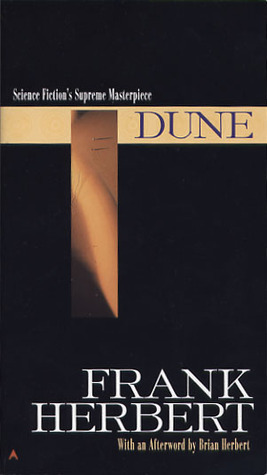
This will be a long review, so I’d like to start with a spoiler-free tl;dr of my opinion on Dune: it’s is an incredibly impressive work of science fiction, especially considering the fact that it was essentially the first of its kind. It’s served as inspiration for so many works and has been outright copied countless times, but I’ve yet to encounter another story that matches this standard of quality in its world building and depth and nuance in its themes. Don’t think it will be an underwhelming experience just because you have already seen the movies and please go read Dune!!
To give a fleshed out and unbiased take on the book, I’ll start with the things I want to criticise, because there were a couple.
Most notably, I found Chani’s character to be disappointingly two-dimensional compared to how she was portrayed in the movie. I wouldn’t have disliked book Chani at all if the movies didn’t exist, but movie Chani allowed me to see her in a new light and to see the potential of giving Paul’s romantic interest a stronger personality and a more complex arc.
Also worth noting that, in my opinion, some fictional psychoactive drugs in Dune, their purposes and “hierarchy”, were a bit unintuitive and unnecessarily complex. At times I felt that the author was relying too heavily on the “it’s a magical substance and I get to decide the rules for it at any point of the work” crutch to explain certain plot points. This is the fantasy aspect I often find disagreeable - if your made-up thing comes with an important rule or principle, I’d like it to be explained or foreshadowed at the beginning lest it feel like an excuse you made up at the end to make your job easier.
Now, for the things I liked, alongside my take on the themes within the book:
While being set in a far away future, religion is still a huge part of Dune’s world. I found this a very unique and interesting decision which makes total sense within the universe, considering that computers are emilinated and society instead relies on the power of the human mind, on subtle almost spiritual aspects like intuition and precognition, and on mind-altering substances to enhance the aforementioned features. The appendix at the end explaining how religion came to be what it is (largely through blatant manipulation by a set of powerful but ultimately ridiculously clueless people) was also a fascinating addition. I don’t think satirising religion was Herbert’s main intention, but he managed to do it in a very subtle and tasteful way while still portraying individual spiritual beliefs and rituals as beneficial, soothing, and aesthetically appealing.
Frank Herbert’s extensive research into ecology really shone through in Dune. I loved how respectful and thoughtful his writing was on certain abiotic natural phenomena, on life cycles, on the resilience and adaptability within different organisms. It was very entertaining to read about a world so scarse in water that it dictates every aspect of life, because we often forget that the most scarce resource is what determines the entire dynamic within the ecosystem, its growth and development. And it’s these types of challenges that life had to overcome at some point during Earth’s early days to eventually establish itself the way it has. One of my favourite moments in the novel was when Jessica discovered the garden in the castle on Arrakis, which went on to briefly become their safe hiding spot. I felt a genuine excitement with her at that moment, and I was so amazed that the book’s world building was so convincing it made me genuinely appreciate the description of something as mundane as a water fountain and some plants.
Time to address the focal point of the book: Paul Atreides. A protagonist so complex and convincing that apparently enough people missed the point for Herbert to be forced to write a sequel. From the start, one thing that is clear about Paul is that he has always been subjected to the extreme pressure of incredibly high expectations. He is the only son of a ruler, and a product of an extremely powerful system, raised to push the limits of what one person is capable of. As soon as he becomes conscious of the responsibility that will fall on him in the near future, he knows that it’s not a welcome one - over and over he thinks of his “terrible purpose”. You can’t help but feel compassion for this 15 year old boy who is suddenly overwhelmed by the feeling that a horrible tragedy lies ahead. You believe in his ability to change this, see the good in him and think that he has the power to steer the course of history into a better direction. This feeling followed me through a large portion of the story, until eventually I realised that this is the exact trap the author wanted me to fall into. When I finished the novel with a clear sense of disillusionment and sadness for the characters who lost their lives along the way and for the many more tragedies that are obvious to follow, I asked myself: Why did I ever feel that it could have gone any different? A person raised with the desire for essentially unlimited power and given the abilities to achieve it is bound to attempt to seize it, and why should we ever expect this to lead to a peaceful, happy ending? I think Paul’s arc is a very clear and tasteful cautionary tale about the destruction and violence that inevitably (!!) follows from the pursuit of unlimited power. The open ending only adds to this, almost as if the author is asking the reader to think for themselves whether they still have some hope for a “happy” ending, for Paul to prevent the tragic holy war.
A scene that for me perfectly encapsulates Paul’s character is the gom jabbar test. He patiently keeps his right hand inside the box of pain, makes the conscious choice to suffer through it for survival, but as soon as the torture is over he looks over to his left hand and sees bloody imprints of his findernails on his palm. The pain, the intention to harm, was put out into the world, and even though it was entirely immaterial at first, it set something very real in motion and inevitably found its way to him in physical form.
So, does free will exist at all? Will everything that is destined to happen happen no matter how hard we try? I really don’t think so. Instead, I think Dune tried to teach us something a little more nuanced: that when people attempt to intervene in systems on a large scale, to seize control not meant for them, it inevitably creates devastating consequences far beyond their understanding, that not even the most powerful minds can control, as seen in the example of the Bene Gesserit. The danger of possessing too much power is the illusion of its absolute nature, which will always come back to bite you in the ass. Similarly, deluding yourself into blindly following a prophetic figure, a messiah, will only seal your fate as collateral damage for his inevitably unsuccessful plan.
Speaking of messiahs, legends and prophecies: there is a passage in Dune that summarises the thoughts I had on the nature and power of a prophecy since the earliest points of the book and was so excited to see put into words by the author himself: ”The prescience, he realized, was an illumination that incorporated the limits of what it revealed—at once a source of accuracy and meaningful error. A kind of Heisenberg indeterminacy intervened: the expenditure of energy that revealed what he saw, changed what he saw.” That is to say - a prophecy will by its nature influence the course of events that it’s foreshadowing. In that way, the gift of prophecy comes with a price of inevitably influencing the future. Once again, a man seeking power over things not meant for his control only creates more unpredictability and chaos.
It’s been a long time since a book left such an impression on me the way Dune did. My only regret is not having read it sooner, because it opened up a new perspective for me that I’m sure will affect the way I enjoy other stories from now on. Straight to my top five!!! Very excited to see what the second book has in store :)
Dune (Dune, #1)
Frank Herbert
Get to the point, you old fool! Feyd-Rautha thought. “You think of me as an old fool,” the Baron said. “I must dissuade you of that.”
now this is quality writing

© 2025 Pagebound