
quests_and_magic_pls
find me where there's angst, political scheming, quests, magic, mystery, and a healthy dose of whimsy 🗡️🏰🌿🍄🧙♀️✨🌌🐉🏔️ // all my comments are edited because I don't believe in proofreading
16015 points




3.71 average · 705 reviews
Click a segment to filter

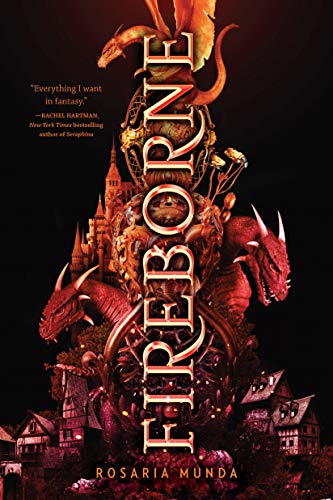
What's better than following along with a revolution, culminating in an evil regime being thrown down? Watching how society rebuilds and seeing all the hard choices that have to be made after, of course. This - along with a fraught teenage friendship and dragon riding - is the essence of Fireborne.
No one warned me how tragic, how tense, how emotional this story would be. Sure, I don't always read synopses, but I figured knowing the book was about dragon riding was enough. NOPE. If you don't know me: Hi, I'm QM, and tragic romances/friendships are my absolute favorite. So I read this story as fast as my little eyes would let me.
In the old world, Annie was a serf under the dragonlord Leon Stormscourge. Our other main character, Lee, was his son. Annie & Lee's worlds both get turned upside down at age 7 when the Revolution happens and a new government is put into power, run by Atreus Athanatos, the leader of the rebellion. They are thrown together by circumstance, and despite it all, grow a delicate friendship & deep understanding of each other. (Most of the story takes place 10 years later, but we do have some flashbacks to Lee & Annie when they are 7-8.)
Annie and Lee's interactions are stilted at times. Quiet. There's a lot of subtle awareness, intimate knowledge, and childlike need in their friendship. They're not quite best friends, but more people who don't know how to survive without each other. Feelings are growing, and watching Annie & Lee untangle their messy past and unhealthy habits is fascinating - and also, irritating at times (sorry, Annie). You desperately want them to be together and to say everything out in the open, but you also understand that they cannot see past the old history. There are paths they do not walk - do not even face - and you can't imagine how they can come together if they both don't start walking, but to walk would be to fall off a cliff.
Anyway, in case you missed it - I was enamored with Annie & Lee and their relationship. This is very much a character-driven story, with the worldbuilding and plot in the background. We see snippets of the new society and how it works (more as the tale goes on), but the focus is not on explanations. It's on Lee. It's on Annie.
Lest you think nothing happens, there are a lot of political moments and moral dilemmas. A society is being rebuilt, and is it better than the old? Is it just a lesser evil? What is 'fair' and 'equal?' Do intentions matter? When does revolution become 'not worth it?' Fascinating glimpses of these conversations and moments are sprinkled throughout the story.
Additionally, because our main characters are trauma-laden teens who have been promised a shining future, we see the reality of war and hard decisions and ethical dilemmas. We see the range of calculating logic to emotional distress at the choices before them. Very engaging, very thought-provoking, and at the same time, full of sorrow.
And finally, the dragons. While this is a dragon rider book, the dragons do not feature as much as I expected. Your perception here may vary, but I was expecting to see more of the dragons as beings in themselves, and less as simply airborne horses. There are hints that more relationship and dragon-knowledge will come about in the future books, but for now, I would recommend the story to fans of political and revolution-based stories rather than dragon fanatics. Fireborne would also be a great entry point to readers uncertain about dragons.
I absolutely loved the writing style. Its ability to capture emotion, subtlety, and nuance is emphasized in its simplicity and clarity. Writing like this is consistently one of the most powerful for me. Let me leave you with some quotes:
ebook pg 106:
"You only deserve this mantle as long as you can be more reasonable and more virtuous than what came before."
ebook pg 213:
Annie smiles suddenly, breathlessly, at the completion of a turn, and I feel an irrepressible smile answer hers; and then the sorrow is transformed into something more, something beautiful, and this, this movement that is so tantalizingly close to flying, that's like the high notes of a violin, some mix of joy and pain, is part of that transformation.
ebook pg 221:
For a moment we continue to stand close, frozen, and I feel that threat of an end rise over us: an end of something that could have started and that I was almost certain I did not want; and worse, more terrifyingly, an end now to what we already had.
ebook pg 300:
"Much of what you'll be doing, as Guardians, will be deciding which is the lesser evil. Who lives, who dies. It will be - it should be - a terrible burden.... It will be your duty to make these decisions, to bear the guilt of them for others' sakes."
ebook pg 319:
I'd thought experience would be a kind of preparation for this conversation, but it turns out that there's no preparation for watching someone's face struggle to understand a new kind of pain.
ebook pg 332:
But surely this is different, surely this crisis, our need, justifies what looks so terrifyingly like a repetition of past wrongs...
ebook pg 361:
This is the refrain she must play for herself, on bad days and after nightmares; this is her refrain, and like mine, it is never enough.
ebook pg 367:
He inhales slowly. "Well, here we are," he says. Like here is the utter end, and he's seen it coming all along.
ebook pg 413:
"The whole point of Atreus's system is that anyone can be worthy."
[Redacted]'s laugh echoes in the empty, glass-walled room.
"Maybe one day," he says. "But for now, I'm pretty sure the point is that some people aren't anymore."

Well. This is the third time I've read The Winner's Curse, and I haven't had enough words for a review until now. Or enough for my liking, that is. (So with that said, keep in mind that I will inevitably be writing from the perspective of knowing how the book - and the series - ends. But no spoilers are in this review!)
Kestrel is the daughter of a renowned Valorian war general, living in the colony of Herran, the Empire's newest acquisition from 10 years ago. The Herrani people were enslaved, and Kestrel has grown up with slaves as a fact of life, especially with her family's status. Her Valorian society is full of balls, parties, and opulent living - but by the time she is 20, she will have to choose either to join the military or get married. Her father's wish for her is evident - to join the military, and use her strategic mind to further the Empire's growth.
Beginning this book, I imagined I might be in for a fluffy tale based on the description and the cover. What I found was an intricate tale of cleverness and emotion. The (almost?) omniscient third-person point of view adds a flowing, ethereal quality to the narration.
The worldbuilding is subtle, though there is a strong ancient Mediterranean atmosphere - orange groves, architecturally lovely villas, rolling hills, a seaside town. No magic is present, and the book could almost be historical fiction (think Greece and Rome). The Herrani people have gods and goddesses and stories about them, so much of their culture revolves around these deities.
Kestrel is a strategic, quiet, compassionate, blunt character. Kestrel's emotions are tangled in many ways: her complicated love for her father, her uncommon sympathy towards the Herrani people, and her penchant for strategy but her lack of desire to use it for the Empire's gain. Her life is one of privilege, and though she feels uncomfortable, she doesn't move to change it.
Enter, Arin. Kestrel buys him at an auction only because the auctioneer says that he can sing. Kestrel has a love of music and even plays the piano - a Herrani activity that is seen as weak among Valorians. For some reason unexplainable to herself, Kestrel is drawn to Arin. He hates her, and things are messy between them.
The changing relationship between Arin and Kestrel is a highlight of the story. Feelings shift, their best and worst sides are shown, and lines are crossed. Kestrel's mind works fast, and her ruthless strategy affects them both. I love the dance between them - how the power dynamics of master and slave affect their ability to be friends and beyond.
At some point, a romance begins to grow between Kestrel and Arin, and it is deliciously slow and angsty and fought against. Any relationship between them - friends or lovers - is not easy, and they are both all too aware of the other factors at play. Honestly, I found the story to be a very mature look at relationships and the factors that complicate them for a YA romance.
The plot is slow at the beginning - this is very much a story focused on people and emotions more than on actions. However, there is a subtle plot thread underneath that comes to a head about halfway through the book. Everything shifts, and another climax happens at the end.
And that ending! It sets up an interesting way forward for the next book, with questions hanging unanswered.
I love these books! I know they're not for everyone, but I enjoy the political scheming, romantic angst, and lovely writing.

Questioning all my life choices due to the fact that I was skeptical about this book based on the synopsis, but then promptly fell in love in the first 50 pages. Is "Fantasy Mystery" my new genre obsession? Why yes, I think it is. Thank you, Robert Jackson Bennett.
Immediately, the worldbuilding had me in awe. You know Brandon Sanderson's books and how they build this incredibly complex world that surely has to be real because of the amount of detail and backstory? Same vibes here. Between the fernpaper walls, the reagents keys to allow passage through the plants guarding a home, and the leviathans whose blood provide special superhuman abilities, I was fully there in the Empire.
BUT, even better - the writing was effortless. There was no initial moment of "okay, gotta slog through this at the beginning and it will all make sense later." From the get-go, I understood everything I needed to and was at home in this new world. I just cannot explain to you how much I loved this combination of accessible but still complex worldbuilding!
My one teeny tiny, itty bitty irk with the worldbuilding was the use of modern cursing. Made-up, in-world cursing would have sealed. the. deal! for me here. Instead, the f-word was frequently present.
Our narrator, Din, was quite externally emotionless. I think I would have liked more peeks into his mind and what emotions lay underneath the surface, but I also think his personality really worked as our narrator. We were allowed to focus on the mystery and take in all the details without fighting off Din's emotional torrent. But, just a warning to those who want deep emotional connection to their characters - you don't necessarily get that here.
Ana, however, was a hoot. Did I know what was going on in her head half of the time? Pshhaaa, no - but did anyone? To create one of those "mad scientist" type characters, you must be careful to make them believable but still retain their air of unattainable skill. Ana was a perfect mix for me - she had some human moments (and Din was able to follow her thoughts sometimes), but she still had that implausible "otherness" that allowed her to be a genius. She was a top character for me!
As for the plot, I was hooked. Just utterly, thoroughly hooked. How I love a good mystery with tension and surprises, and give it to me in a fantasy world?! Perfection.
The ending (ie, the resolution of the murder mystery) fell right into the careful balance of believable, adequately scaled, and conclusive without being too neatly aligned. I'm excited to see where Ana and Din go next, because I am feeling the inklings of an underlying thread that may come out more in further works.
Wow! Who knew book two of the Shadow of the Leviathan series would become highly anticipated for me? Be sure to give this one a try if you like genre-bending stories, accessible fantasy, and plant-based worldbuilding!
Thank you to NetGalley and Del Rey for the gifted ebook copy. All opinions and thoughts are fully and genuinely my own.
A Trade of Blood (Shadow of the Leviathan, #3)
Robert Jackson Bennett


I’m intrigued about why readers over 30 years old enjoy YA books. I don’t read YA myself, as the dialogue I've looked through felt somewhat immediate/childish, and I thought the themes would suit younger readers, yet I see intense violence and sex being quite frequent in those books.
What pulls you into YA? Characters, pacing, or something unique? I'm genuinely curious, and would love to hear your thoughts in a friendly chat! 😊 Maybe you'll manage to convince me to try and read some YA.



© 2025 Pagebound
quests_and_magic_pls commented...
I read MG and I'd love to share my reasons! I'm 25, so not over 30 and wasn't going to contribute to this discussion on YA, but was reading the responses cause I'm nosy and interested :)
I read MG occasionally, as in, MAX 5 books MG per year. I only read fantasy MG (same genre I read in YA & Adult). There's a purely imaginative quality to fantasy MG that you can hardly find elsewhere - those elements of coming up with inventive creatures, plots, and magics just because, revelling in what creativity can do. Most YAs start getting heavy and dark, to show themes that age group is dealing with. MG is usually more... Escapist? Focusing on the good things in life? Hopeful? There may be heavy themes (especially in upper MG) but the tone is so hopeful. It's something I enjoy so much on occasion.
Also, there's a distinct line in MG - the very much "kids books" and the "are we sure this is only a kids book?". Lol. Similar to classic Disney animations - they're "for kids" but adults love them too, for the themes, fun, magic, etc.