
Bluehairedboy
She/they. le Ge be teh quah💓💜💙. Currently obsessing over The Jasad Heir and her husband the Nizahl heir.
12719 points


3.85 average · 619 reviews
Click a segment to filter




Today I suddenly noticed that my avatar had a crown. I even made a post about it after reporting it — thinking it was a bug. I was very concerned that I was being charged money I didn't have and it felt unfair to those who had actually paid to support the community! But the people in PageBound pointed out that it may have been a gift and it was! They even helped me find the person — @JustABookNerd—who gifted me PageBound royalty after reading my comment on a founders announcement. @JustABookNerd gifted me 6 MONTHS of royalty. And I'm truly so grateful.
I'm one of the primary caretakers of my brother and my cat. I got my cat after a particularly rough time in London. He's my little bundle of joy and my whole heart. After coming to India, my saved up salary from previous job went to caring towards to my brother and adopting my cat. I started my new job last month and got my salary this month. However, two weeks ago, the vet said my little baby boy had cryptorchidism which meant that his risks of getting cancer were higher. He underwent neutering to prevent it and my salary paid off his medical bills. I also installed an AC in my room so he could heal comfortably and the tropical heat of Visakhapatnam would not impair his healing process. It's been about a week since he got neutered. And he's healing well!. Though he got a bit too excited when the vet said he could go cone free and licked his surgery site and now the cone is back on for another week.
From next month onward, I really wanted to get PageBound royalty to support this wonderful app and community.
And you can totally see why that want was so justified. This is such a beautiful community that deserves so much support! @JustABookNerd has done something so kind and wonderful because now I have something for myself and I can participate in this community to its fullest! I truly hope you can send some words of kindness and love to them. You can view their post about this here
Also shoutout to @bluejjongs and @ex.astris.scientia for helping me find @JustABookNerd. Could not have done this without you two. Hope you guys send some love to them too!
And @lucyPagebound @JenniferPageBound - please ignore my report!
And I really hope this helps you guys in donating Royalty if you want to and are able to!
Hello everyone, and welcome to my TED Talk. I was a philosophy minor during my undergrad and I want to talk about one of my favourite ideas. This is going to be a bit of a long one, so grab a cup of coffee, some tea, or a packet of biscuits, and settle in. Let me introduce you to the idea of radical alterity and Luce Irigaray's concept of "I love to you." Now, this might sound strange at first, but bear with me.
What our culture celebrates as romantic love is often not love at all. More often than not, it's possession. To explain this, we need to start with Emmanuel Levinas and his idea of totality. Totality is our tendency to reduce another person to something we can completely understand, define, categorise, and possess. We use labels and assumptions to bring the other person into our own world until they become familiar, predictable, and, ultimately, an extension of ourselves. In other words, we force the other to become the same. The problem is that, in doing so, we erase their independent selfhood. To completely know someone is, in a sense, to destroy them.
Levinas argues that we never truly know another person because they will always remain other. There will always be something beyond our understanding, something irreducible. Instead of totality, he proposes infinity—the recognition that another person always exceeds our understanding. That distance is not a failure of intimacy. It's an ethical responsibility. To stand before another person is to recognise their vulnerability while accepting that they can never be fully consumed by our own ego.
This is where Luce Irigaray builds on Levinas' philosophy. She argues that there is a way to love someone without erasing them, and surprisingly, it begins with language. Instead of saying "I love you," she proposes "I love to you." It seems like a tiny grammatical change, but philosophically it's enormous.
"I love you" turns the other into the direct object of the sentence. Love becomes something imposed upon them, something that possesses. "I love to you," however, preserves distance. It acknowledges that love moves towards another person without claiming ownership over them. It allows them to remain fully themselves.
It's the difference between saying: "You belong to me." and "You belong with me."
That boundary matters. Without it, Irigaray argues, we engage in what she calls cultural cannibalism. We consume the other person, turning them into a reflection of ourselves in order to satisfy our own ego. Their difference disappears because we cannot tolerate it. This is remarkably similar to Levinas' idea of totality.
Whether we call it totality or cultural cannibalism, the result is the same: the other person is absorbed into our own identity, and their selfhood disappears. The alternative is proximity. Proximity means standing beside someone rather than swallowing them whole. It means recognising their infinity, accepting responsibility towards them, conversing with them, and allowing them to remain unknowable. That is what radical alterity asks of us. Now, you might be wondering why I'm talking about all this.
Because I think this philosophy perfectly explains the kinds of love we see in Obsession by Curry Barker and Wuthering Heights by Emily Brontë.
Let's start with Obsession. When Bear makes his wish, he completely erases Nikki's autonomy. By taking away her freedom, he destroys the very person he claims to love. Nikki ceases to exist as an independent individual and instead becomes an extension of Bear's desire. Ironically, the moment he gets what he wants, he loses the Nikki he loved in the first place. His wish becomes a literal metaphor for consumption.
He cannot tolerate the possibility that Nikki, as an autonomous person, might not choose him. Rather than facing her as she is, even when she asks him, "Do you have something to say to me?; he chooses certainty, makes the wish, and consumes her instead. In doing so, he obliterates the "to" in "I love to you." He replaces it with possession. He replaces uncertainty with "She is mine." But that certainty comes at the cost of Nikki herself and the responsibility of looking at the Face of the Other and its demands. He, instead, imposes his will on the Other. This is seen in the customer service phone call the customer service guy tells Bear that he has the moral obligation to be there for her. Which is to say, face her and really look at her. But he doesn't. What I'm trying to say is that the uncertainty exacted the cost of destroying the Nikki he loved because by posessing her, she didn't exist anymore. She was just an extension of himself. Levinas says that by trying to totalise the other, you make them an entity in a plastic form. Remind you of Nikki post wish?
Wuthering Heights presents two completely different models of love. The first is Catherine and Heathcliff. Their relationship is the peak rejection of radical alterity. Neither can exist without the other because each attempts to collapse the other into themselves. Catherine famously declares, "I am Heathcliff," and later says, "Whatever our souls are made of, his and mine are the same." It's a closed loop. Difference disappears. And without difference, there is no ethical relationship. Their love becomes this total singularity with no room for ethical connection, leading to violence and madness. It becomes obsession. They consume one another until all that remains is destruction and revenge.
Heathcliff repeats this same violence with Hareton. Just as he and Catherine tried to erase one another's individuality, Heathcliff attempts to remake Hareton in his own image. He deliberately denies him education just as Heathcliff was. Again, another person becomes merely an extension of Heathcliff's ego. There is no difference between the violence imposed on Catherine and the violence imposed on Hareton because they've become objects in his world. But then Brontë gives us Cathy and Hareton. Their relationship is built on mutuality rather than possession. Cathy is educated. Hareton is not. Neither tries to erase that difference. Instead, they acknowledge it and their intimacy develops through shared labour and shared learning. Cathy teaches Hareton to read, but she never tries to make him into another version of herself. Hareton grows without surrendering his identity. Unlike Heathcliff and Catherine, Cathy doesn't demand sameness. Their relationship is one of standing beside one another, looking in the same direction rather than collapsing into one another. They maintain the boundary that Catherine and Heathcliff could never preserve. That's what makes their love ethical.
Both Obsession and Wuthering Heights ask the same question: what happens when love becomes possession? The answer is that it destroys the very person it claims to cherish. True love exists not in total fusion but in proximity. It asks us to accept that the people we love will always remain, in some ways, mysterious. The ethics of love therefore require profound humility. They require us to accept that we will never know another person completely. The moment we claim to have mapped someone entirely, we reduce them to an object within our grasp. We stop encountering them as another consciousness and start treating them as our possession. Real love exists in the space between you and me. It exists in distance and in the irreducible mystery between us that prevents love from becoming property.
Perhaps that's why Irigaray asks us to rethink such a familiar phrase. Maybe we shouldn't say, "You belong to me." Maybe we should say, "You belong with me." Maybe we shouldn't say, "I love you." Maybe we should say, "I love to you." Because the other person is, in many ways, like God. You can stand before them. You can move towards them. You can give them love. But you can never fully know them because they're always beyond grasp. They're unknowable and infinite and like Levinas says, and I paraphrase, you stand as a servant to that infinity.
Thank you so much for reading this TED TALK. I would like to know your thoughts on this concept regardless of whether this is familiar or new to you!
If you guys want to read about this in detail then please check out Chapter 2 of Ethics, Aesthetics, and Education: A Levinasian Approach by Donald S. Blumenfeld-Jones and Chapter 10 of I Love to You - Sketch for a Felicity Within History by Luce Irigaray. These are incredibly beautiful works.

Hello Stranger
Katherine Center
Bluehairedboy commented...
Hopefully this works- here's Brew 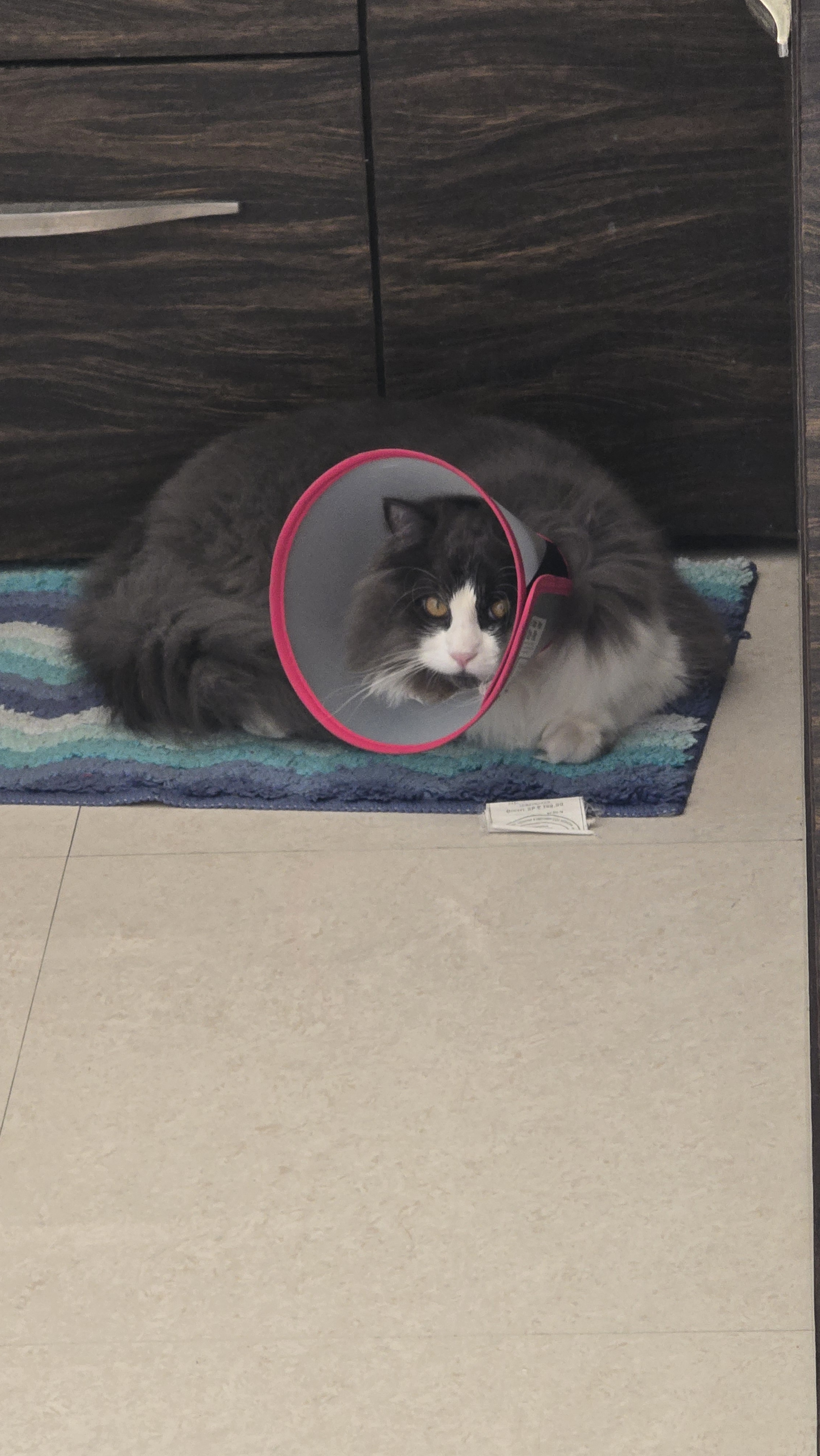
Today I suddenly noticed that my avatar had a crown. I even made a post about it after reporting it — thinking it was a bug. I was very concerned that I was being charged money I didn't have and it felt unfair to those who had actually paid to support the community! But the people in PageBound pointed out that it may have been a gift and it was! They even helped me find the person — @JustABookNerd—who gifted me PageBound royalty after reading my comment on a founders announcement. @JustABookNerd gifted me 6 MONTHS of royalty. And I'm truly so grateful.
I'm one of the primary caretakers of my brother and my cat. I got my cat after a particularly rough time in London. He's my little bundle of joy and my whole heart. After coming to India, my saved up salary from previous job went to caring towards to my brother and adopting my cat. I started my new job last month and got my salary this month. However, two weeks ago, the vet said my little baby boy had cryptorchidism which meant that his risks of getting cancer were higher. He underwent neutering to prevent it and my salary paid off his medical bills. I also installed an AC in my room so he could heal comfortably and the tropical heat of Visakhapatnam would not impair his healing process. It's been about a week since he got neutered. And he's healing well!. Though he got a bit too excited when the vet said he could go cone free and licked his surgery site and now the cone is back on for another week.
From next month onward, I really wanted to get PageBound royalty to support this wonderful app and community.
And you can totally see why that want was so justified. This is such a beautiful community that deserves so much support! @JustABookNerd has done something so kind and wonderful because now I have something for myself and I can participate in this community to its fullest! I truly hope you can send some words of kindness and love to them. You can view their post about this here
Also shoutout to @bluejjongs and @ex.astris.scientia for helping me find @JustABookNerd. Could not have done this without you two. Hope you guys send some love to them too!
And @lucyPagebound @JenniferPageBound - please ignore my report!
And I really hope this helps you guys in donating Royalty if you want to and are able to!
Bluehairedboy commented...
Not you casually hating on some of my favourite books 😭😭😭
I love it. We love diversity of thought.
That being said. I absolutely hated powerless (it's a rip off of Red queen), ACOTAR (I don't need to read about so much faerie dick), From Blood and Ash (cause what the fuck was that book), and any book by Colleen Hoover. My Vampire Plus One was also abysmal. I have so many more that I can't possibly list them all.

It's great when you meet people who love your favorite books. You know what's even better? Finding people who hate the same books as you do!
I often go find one-star reviews of books I despise and give the reviewer a follow. It's funny to me that mutual hatred is more often a better predictor of shared taste than mutual endorsement :))
Here are some popular books I cannot stand or found underwhelming (apologies if this offends anyone here):
First and foremost, the star of the show: A Little Life ✨: this is easily one of my MOST HATED books of all time. I could make a five-hour video explaining why that is, but others have already done that. I hate it so much I'm using it as a coaster just to be disrespectful.
Mistborn by Brandon Sanderson: I know, I know, this is a favorite among many. This one I don't "hate" tbh, I just didn't care for the writing, the corny dialogue, the characters, and some plot points I found ridiculous. The world-building and the magic system was cool though. (I had this feeling it would be a much better experience as a video game!)
The Jade City: yes, another very popular fantasy, but I disliked it so much I DNF'd it after 100 pages. I really hated the objectification and over-sexualization of female characters, and I didn't care for the male characters or the plot either.
The Goldfinch by Donna Tart: I'm a sucker for big, slow-paced books with good writing so I had high hopes for this one but good grief this one KILLED ME. It was SUCH A DRAG. loved the prose but this did not have nearly enough substance to justify this much yapping. I might read her other book though.
The name of the wind by Patrick Rothfuss: I read this many years ago in farsi and I don't remember much except the main character was very clearly the writers' self insert and utterly insufferable. Some say this has good prose, but I read a translated version so this had no redeeming qualities for me.
What are your most hated books? Name them in the comments and see if you can find friends:))
Bluehairedboy commented...
We don't want ai slop in this house. Boycott this man.

I decided to dnf ali abdaal's book "feel good productivity" because he keeps promoting ai stuff in his videos and as an artist and writer I have a strong anti ai stance so I didn't want to compromise my morals for a book that did have good things to say but I can't really accept the knowledge in good faith anymore.
Was this petty of me? Genuinely curious
Edit: Thank you all for reassuring me in this decision. I'm glad I got a lot of kind responses on this : ]

© 2025 Pagebound