
mermaidadjacent
fiction-only reader turned nonfiction-only reader trying to find balance between those two extremes
671 points




3.29 average · 73 reviews
Click a segment to filter
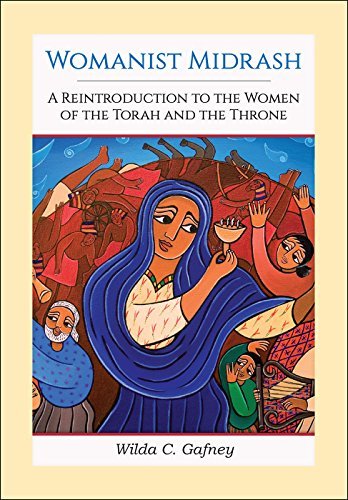
This book has been foundational to my study of Torah and of many women in the Tanakh. At times, Gafney's translations or interpretations conflict with traditional translations; I don't think that this necessarily means that hers are invalid or inaccurate, but rather that the traditional ones might be lacking. For example, early on in this book, she asserts that there is no Biblical Hebrew word for "wife". This is true but technically a bit misleading, because in Biblical Hebrew, the word isha can mean either "woman" or "wife." Similarly, the word ish can mean either "man" or "husband." So there is no Biblical Hebrew word that exclusively means "wife," but there is technically a word for it.
However, despite the confusion that this technicality inspired in me, her main point in this section was to justify translating isha as "woman" in the context of Adam and Chava's union, despite it being traditionally translated as "wife." I think this translation decision on her part was not only accurate but deeply meaningful, and it enriched my connection to the original text. After all, the assumption that they must have been husband and wife rather than man and woman is rooted in the cultural norms of the translators, not necessarily the original intent of the text. By understanding Adam and Chava merely as man and woman, and stripping away our assumptions about them, we can get closer to the story itself and open so many doors for its interpretation.
This sort of clarity regarding the Torah characterizes Gafney's analysis of it, and it is incredibly enriching to read. Gafney also faces many of the hard topics which people attempt to ignore or downplay about these holy books—especially the subjugation of women and the pervasiveness of slavery. To be honest, I don't think that I would have been able to reconnect to the Torah at all without this kind of brutally honest examination which allows it to be flawed. I recommend this book wholeheartedly to anyone who is experiencing their own reckoning.
edit: this review was shared on StoryGraph in February 2025 and imported to PageBound on the date above.
This book is important to me.
mermaidadjacent commented...
Thank you so much for sharing this! It's so cute and so helpful. I did notice that when I downloaded it as an .ods file, the check-mark feature broke, because Google Sheets and Libre Office use different logic to handle check-marks. I edited it to work natively in Libre Office and added some pages for nonfiction ratings (since I read a lot of nonfiction lol), and I figured I'd share it here in case any other Libre Office users would like to use it without having to sink a couple of hours into Calc!
🔗 Here is a link to a cryptpad.fr page where you can download the .ods file.
🔗 And here is a guide to Libre Office check-boxes, in case anyone ends up wanting to move the check-boxes around or anything.

i am aware most people are not as into spreadsheets as i am, but if anyone is interested in it (or just likes making things as structured as possible), i'm sharing my rating spreadsheet below
this is what i actually use to rate most books (i don't use it always, specially with older / classic books, because i think the categories don't quite reflect what's actually relevant in classics). overall, though, it really helps me organize my feelings and think of an evaluation that better reflects my opinion on each book
it's super simple: there's 5 categories, each worth 1 star. every category has then 3 possible ratings: zero, half, and 1 whole star. just check whichever option makes more sense and the spreadsheet adds up the numbers automatically ❤️ and provides you with the final rating in the bottom ❤️ magic. seriously, how can people not appreciate the beauty of spreadsheets? /j
i came up with the qualitative descriptions to help assign a rating to each category, but if you want to use this template, you can write them however you'd like, of course. i mostly wrote what made sense to me. use it however you want!
🔗 my book rating spreadsheet - view only | 🔗 my book rating spreadsheet - make a copy
it has two different color options in case you have beef with green+pink. to edit the template, make a copy :)
and follow me for more oddly specific sheet(s) 😘 lol
mermaidadjacent commented...
Many of my favorites have already been mentioned in this thread (or shared in one of the lists here), so I'd like to share about a particular author whose work has been incredibly influential on my life but who I rarely hear others talk about.
Transformative justice and restorative justice (TJ/RJ) have exploded in popularity in the last few years. Nowadays, it is not uncommon for me to hear other anarchists in certain circles speak as if it is a foregone conclusion that TJ/RJ is the whole of "anarchist justice." Virtually every single book or article or resource that I have been recommended myself or seen recommended online on the topic of radical or anarchist justice has been a TJ/RJ text. In my life, I have repeatedly seen TJ/RJ lingo and practices be used to silence victims/survivors, rehabilitate abusers' and rapists' reputations, and maintain the status quo.
Destroy What Destroys You is an essay collection by Lee Cicuta that explores an alternative anarchic vision of intimate authoritarianism, also known as intimate partner violence (IPV), domestic violence (DV), or abuse. Her framework asserts that these forms of violence are not merely violence; they are authoritarianism itself, expressions of the forces of domination and oppression that anarchists define ourselves in opposition to. She examines how liberal non-violence propaganda has played a role in watering down both abolitionism and anti-authoritarianism; how common myths and even bystander questions about abuse reinforce the cultural staying power of intimate authoritarianism; and how intimate authoritarianism is supported by and reproduces all other forms of authoritarianism. I found each of her essays to be clear, compelling, and personally moving.
If you'd like to give her a read, you can download Destroy What Destroys You for free at this link.

Hello! I'm looking for book recommendations focused on Anarchism, Anarcho-Communism, Anarcho-Syndicalism etcetc. Both well known literature and obscure niche favs. Fiction or non-fiction. I just want to find out how Anarchists think/dream/imagine their future, since it is the Ideology I know the least about. Preferably with a positive portrayal, as everything I know about Anarchism thus far is conservative propaganda.
Thanks!
© 2025 Pagebound