
yourartistfriend
Izz ~ she/her 🏳️🌈 | Illustrator by day ☀️ Tarot reader and witchcraft practitioner by night 🌙
8054 points


4.03 average · 36 reviews
Click a segment to filter
There is so much I could say about this book, but I keep returning to this:
I want this book printed on cheap paper. So it’s precious to our heart and mind, but not in a way that it finds a permanent home on a spotless shelf, with pages intact.
These pages were made to catch our tears as they slide down our cheek. They were made to be rolled up and bent out of shape, so you can carry this book in your bag or coat pocket when you need it with you. And so you can read it in bed when you can’t sleep, and not get concerned the next day when you discover it somehow ended up open, under your pillow.
I want this book to be so affordable, you can lend it to comrades without worrying about it making its way back to you... Because this book feels like a gift: full of endless hope, yet completely grounded in reality of the fight for collective liberation.

This is a really well intentioned book that unfortunately missed the mark for me. _
At the beginning of the book the author claims: “If you know lots about witchcraft, but nothing about politics outside a voting booth, this book is for you. If you know loads about politics, but your knowledge of witchcraft begins and ends with Harry Potter, this book is for you, too.”
After reading I can confidently say that my impression of the book was that only the second claim is true, or more accurately, I believe this book was mostly directed at sceptics. On its own, there is nothing wrong with writing a book on witchcraft directed at people who don’t yet know if they believe or want to take part in the practice, but that is unfortunately not how this book was marketed or presented in the introduction.
The author discusses the importance of community, connecting with the land we live on, bringing up important moments where community came together to fight for an important cause, such as Standing stones and the AIDS epidemic. She also mentions how you don't need tools to practice effectively and how witchcraft is for everybody. I can get behind a lot of what the author is saying, however she has a specific approach to this topic that did not work for me.
Various concepts from witchcraft and other magical practices were defined very loosely here. For instance, the author says “being initiated is like falling in love. You just know it when it happens”, which would not be accurate by most common definitions of initiation. She also says that “all protests are spells”. The author uses Crowley’s definition of magic to inform this statement (which she quotes as ”Magic is the art and science of causing change in accordance with the Will") and takes it completely literally, making it seem like all change we create in the world is inherently magic. By this logic, deciding to flip the switch and turn on the light in a room would be magic, as it is technically causing change in accordance with our will. This would not be considered accurate by most widely accepted beliefs in the magical community. This is not to say that the author can’t have her own definitions of these things that simply work better for her. All I am saying is that this approach didn’t work for me, as I believe it banalizes and oversimplifies witchcraft unnecessarily. Also, activism can stand on its own as a powerful, meaningful thing. It does not need to be associated with witchcraft to be that.
In the section about sigils, the author mentions in passing how: “There are even programs online that will generate [sigils] for you”. It feels all sorts of counterintuitive to encourage people to use shortcuts with AI when it comes to something as involved as creating magickal symbols. Same as attempting to generate any other form of art, this does not sit right with me, and it reminds me of people who use AI to read their tarot, something which renders the practice completely pointless.
There are multiple instances in the book that feel slightly patronizing. In one instance the author says *“Remember when I spent an entire chapter defining what witchcraft is and you were still kind of confused?” and there were other comments like ”Did I just blow your mind?” I can tell this was supposed to be funny, and I’m sure it wasn’t malicious in intent, but there is no reason to assume your reader was confused after reading a chapter from your book, especially since you claim the book is for more seasoned practitioners as well as for beginners.
One thing that really bothered me is that there is no bibliography in the book. It seems like a book on this topic really needs some decent references, and I was really disappointed to find that this wasn’t taken into consideration at all. _
Every time I see books on this topic I am so excited that the magical community is out there proudly fighting for justice and trying to inspire others to do the same. But I strongly believe that genuine critique is good. We critique things like books and movies because we want the entire industry to get better, not because we want to make those creators feel bad about what they created. This book isn't a terrible resource, but I didn’t think it was a good one either, which is why I wouldn’t recommend it. We can do so much better.


Hello friends. I hope you’re doing well.
It’s October, and seasonal changes are in full swing where I live. This year, they caught me at a particularly vulnerable time emotionally, and I haven’t been able to connect with the subtle shifts in energy, or to get excited about going into the last few months of the year. I suppose we go through seasons the same way the environment around us does. If you’re going through something uncomfortable right now, you’re not alone. And we’ll be okay.
Before doing this month’s reading I finally got myself out of the house and went for a walk. I live in a city but we have this one big hill right in the middle of it with a beautiful forest. It felt nice to touch the damp tree trunks and collect shiny chestnuts while walking around for a while. Now I’m sitting on my bed with a big cup of chai, writing to you before shuffling my tarot deck. I’m excited to see what book-related inspiration and advice this month has in store for us, so if my random personal musings haven’t made you scroll away already, let us get shuffling and look at some cards together.
How this works
I pull some cards for us and write a little bit about what I’m seeing when it comes to reading inspiration for the month ahead. You are welcome to simply take what resonates from the reading and move on with your day, or, if you think of any specific books that align with what I’m describing, comment those titles down below for people to check out. These readings don’t aim to be particularly predictive, and they aren’t meant to be taken as gospel. This is simply a bit of fun, something to bring you some reading inspiration if you need it, and an opportunity for us to further connect as a community. _
I’m using the Lilifer tarot deck, created by Marion Costentin, published by Little Darkness. The spread is designed by me. The journal sitting underneath the cards on the left is designed by Shayna Klee, aka Purple Palace.
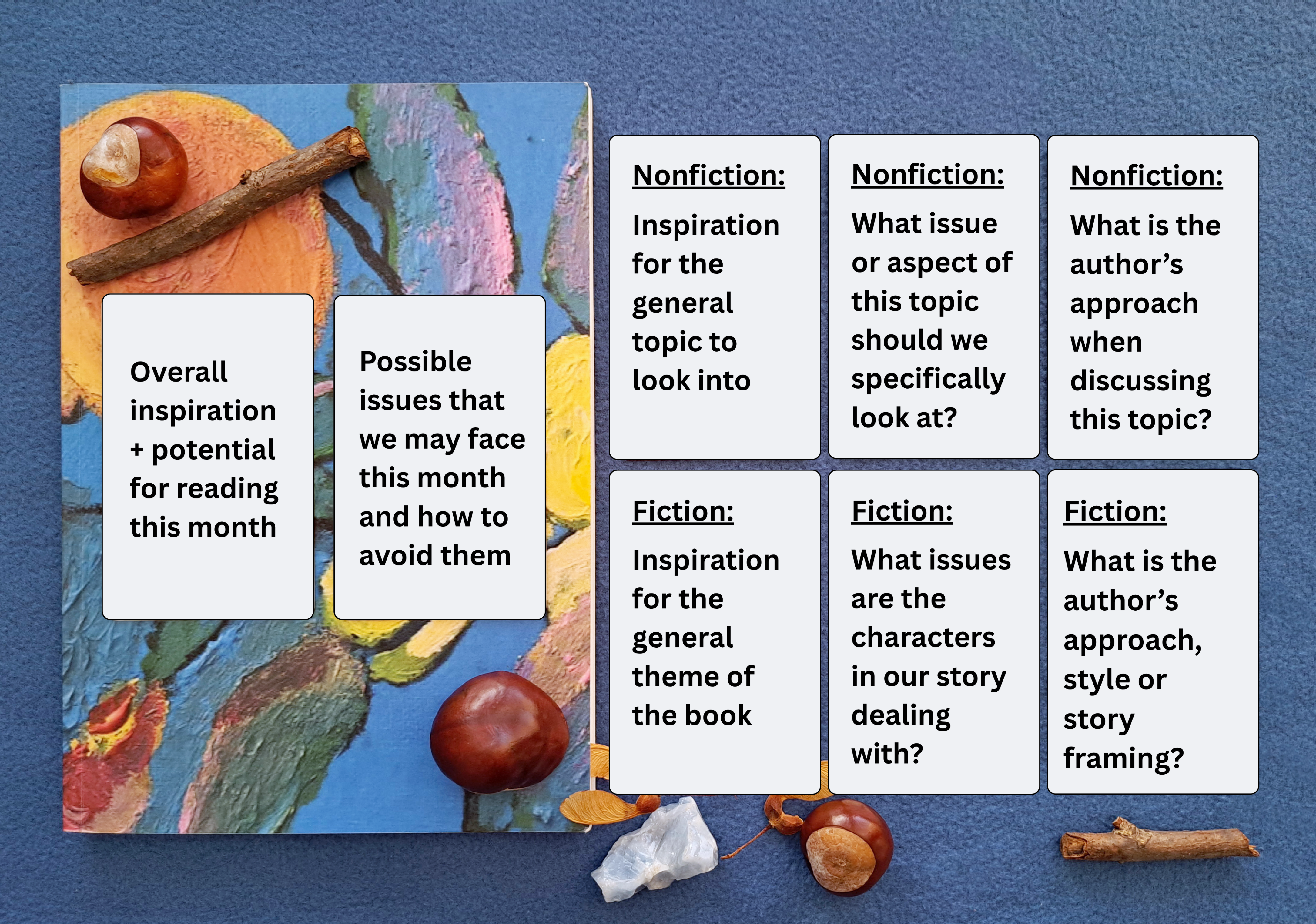
Here are the questions we will be looking at, and the cards we got. For a better experience, I recommend viewing the pictures below on the Pagebound website!
 .
.
To start we’ll be looking at some general advice from the cards on the left side.
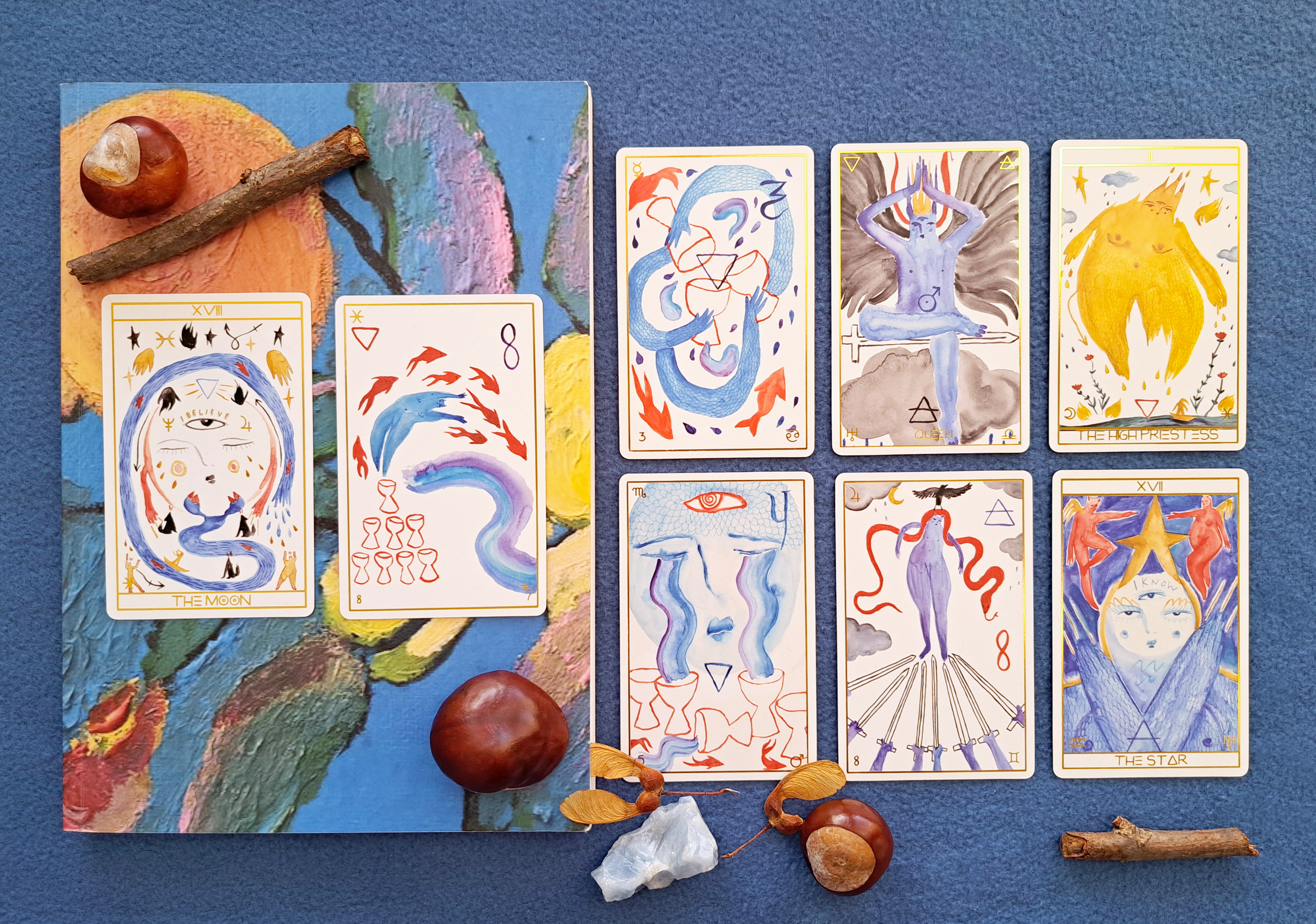
Our inspiration and potential for reading books is symbolized by The Moon card. With this card we aren’t looking at reaching very specific milestones or going through loads of books from our TBR pile (although it isn’t suggesting that this won’t happen). The domain of this card is more related to immaterial gains. It’s a call to explore our expansive inner worlds further, and to allow ourselves to be more introspective while reading to see what we can learn about ourselves, even if it gets a bit uncomfortable and disorienting at times.
Our second card, the Eight of Cups, talks about going on a journey of some kind, often somewhere we have not been before. There is a nod towards leaving something behind before taking off on this journey, and, for us, this could be an encouragement to get a little adventurous with our reading. It might be good for us to leave our comfort zone for a short while and see what we could gain from that experience.
Look at the illustrations on these two cards side by side (you might want to open this post on desktop to be able to see them up close). If you imagine The Moon is the bigger picture here, the overall potential that we can tap into, the Eight of Cups is a detail from that picture. Notice the blue wave in both of the cards. In The Moon, it goes up and around, freely moving through space. Now imagine we zoom into one part of that wave, and there we see the figure from the Eight of Cups, looking like they are just about to jump in and embark on the journey that this wave will take them on. Since the second card is talking about the issues we might run into, here we are acknowledging how intimidating it can be to take that first step.
The main message that this card pair is giving us today lies in the red fish. Notice how the figure from the Eight of Cups is surrounded by them, and how they also appear seamlessly swimming through the water in The Moon* card? This is a reminder that we aren’t alone. If we are intimidated by specific books, themes, or genres, but are finding ourselves intrigued, there are many people who are either in the same boat as us and would love company, or who have been there before and are happy to share what they learned. I think Pagebound is a perfect space for this, so we don’t have to go far to organize buddy-reads, dive into discussions about the books we're reading, or ask questions and share our experiences here in the PB club.
The red fish are also a reminder that when we’re outside looking in, these things usually seem way scarier than they really are. The moon is such that it doesn’t illuminate everything, and when we can’t discern what’s what, fear can kick in and we can fill in the blanks with all the wrong things. Since the fish have already been through the mystical waters of The Moon card before, they aren’t scared and they don’t hesitate to jump in with the figure from the Eight of Cups. Knowledge of ourselves gives us power and allows us to grow… and as living beings, we must grow.
_
Let’s look at the three cards on the top right and see what inspiration we can get when it comes to non-fiction reads.
We’re looking at the first two cards as a pair. The first card talks about the general theme to look into for non-fiction, and with the Three of Cups, we are talking about community and our place in it. The Cups are the suit of emotion, so we are looking at the things that connect us with each other and remind us we aren’t alone. It’s an illustration of how intertwined we are with each other, and a reminder that nothing in life is truly free of influence from the people around us, and that’s exactly how things should be.
The Queen of Swords comes in to clarify that we should specifically look at the ways in which we show up for our community. This Queen has a strong sense of justice, and they aren’t afraid to make sacrifices in order to stand up for what’s right. Equally, this Queen is ready to call us out when we aren’t doing as much as we know we could be to support those that we share this planet with. There is a clear suggestion that the books we should consider for October should be addressing some of these more difficult questions. It’s a reminder to not allow community to be just a buzzword for us, something we support in theory but not enough in the ways that truly matter.
The High Priestess here represents the style of the books that we may want to look into on this topic. This card often symbolizes that which can only be attained through deep soul-searching and connecting with something bigger than ourselves. What this might mean for us is taking a more holistic approach to this topic, and considering not just how we support the people around us and those who live far away from us, but also how we treat the natural world. There is contemplative energy here, so it might be good for us to seek books which look beyond what’s obvious, so we can develop a deeper understanding of our values, our relationship with nature, and what it is that we can really offer to this world. _
For those of us who are more into fiction, let us look at the bottom row for some ideas.
We are first met with the Five of Cups to symbolize the main storyline. This is a card of heavy feelings. There is sadness here which often becomes overwhelming, so much so that it is blinding our main character(s), often preventing them from seeing any of the positive things in their life. The focus of the story is an emotional journey that our characters are going through, and we can see this from how zoomed in we are on this figure’s face. The emotions are big and they aren’t hiding them from us. We are seeing straight into their soul.
Now, the energy of the Fives in tarot sits in the middle of the minor arcana for a reason. This is not the end of the story for our characters, and they need to figure out how to deal with this and grow around it. This is where our second card comes in.
The Eight of Swords is here to tell us about what our main characters are struggling with the most on this journey, and what I’m seeing from this is that a lot of this helplessness and loneliness is self-imposed. Our character is not actually completely on their own, but they have convinced themselves that it is so. They might also be dealing with a fear of rejection, which isn’t allowing them to let new people in and accept the help that is available to them. This might be due to traumatic experiences from the past, or the fact that they need to look beyond their immediate environment to find their people.
The last card is what really defines the type of story that we are talking about here. The Star is bringing us an optimistic message, suggesting that we pick up fiction books which deal with difficult topics but have an obvious hopeful throughline. Don’t make the mistake of confusing hopeful for shallow. The Star is deep but nourishing. It symbolizes trusting ourselves and giving ourselves grace, which is very different from what we are seeing in the Eight of Swords. This is telling me that our character goes through a transformation in this story, as they re-learn how to trust themselves, and how to accept help. There is gentleness and vulnerability in The Star, and that’s the kind of writing style we might want to seek out for our fiction books this October.
_
That’s a wrap on our October reading!
I really hope this month treats you with the same gentleness we just talked about in The Star card. Best of luck with your reading plans, and if the book inspiration section reminded you of any specific titles, it would be kind of awesome of you to leave them in the comments, in case someone is looking for ideas. Juuust saying.. :)
Thank you for stopping by, friends. _
Previous readings: September 2026 August 2026 July 2026 June 2026 May 2026 April 2026 March 2026 February 2026 January 2026 .

yourartistfriend commented...
I thought this was fucking great, y'all. I read this because I was proposing some event concepts, and while I didn't use everything from here, I can already tell that the proposals turned out 10x better compared to what they would have been if I didn't have this book. No fluff, loads of good examples, fun read. I will probably do a review at some point (in my life, lol) but I recommend this.
yourartistfriend finished a book
22w

The Art of Gathering: How We Meet and Why It Matters
Priya Parker
yourartistfriend commented...
Whichever sweet person gifted me PB royalty for six whole months and by doing so also supported our lovely founders, you've got a free tarot reading with me, if that happens to be something you'd enjoy. In any case, thank you for such a sweet gesture ⚘️♡ I appreciate you!


© 2025 Pagebound
yourartistfriend commented...
This was such a good time. I highly recommend it. I haven't written any reviews in ages but I'll write one for this to elaborate on my thoughts because I really hope people pick this one up!
( I'm honestly tempted to go back to the beginning and read it again but I have too many books yet to read this year so I'll try not to....
UNLESS it's a buddy read?👀 )