
groupprojects
- sara (she/her) / se michigan - a couple of theater degrees - horror, apocalypse, weird stuff mostly - if i’m not reading i’m probably on a walk or rewatching a show about vampires
10062 points








3.94 average · 59 reviews
Click a segment to filter

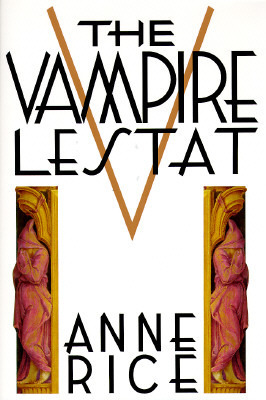
This book rocks (pun intended). If Interview with the Vampire is like 🔗watching a memory slowly unfurling behind stained glass, The Vampire Lestat is someone grabbing your face and forcing you to listen to them while they smash through that glass.
This book is sprawling, campy, philosophical, emotional, a genuine pleasure to read. Lestat is a delightful, self-assured, tortured narrator who thrills at the opportunity to finally speak (and sing) for himself.
The thing I knew about this book before I read it was just "vampire becomes a rock star," which sounds so silly but, 1. is reductive of the actual breadth of this novel, and 2. is completely understandable and justified for this character (someone who has always loved music, and attention).
The plot is so fun, and so fascinating: Lestat's tragic childhood, his chaotic life as a vampire, his tumultuous relationships, the stories and lore of other older vampires. Fully-realized and truly incredible. And extremely thought provoking! I didn't even post everything that I wanted to -- this book absolutely consumed my mind as I was reading it. See the following posts (beware spoilers): one, two, three, four, five, six.
Anne Rice's writing continues to astound. I continue to be obsessed with the show, and reading this book has further enriched that experience. Wow, y'all. I really love this world and this curious, loving, self-destructive vampire in particular.

I loved this. So funny, complex, incisive, and tender. People are so many things, so many people.
Really hit for me as a person in my thirties who is watching people reach traditional “milestones” and simultaneously feeling left out and like I’m above it all, not really wanting any of it but still feeling wrong sometimes for not having it. Life is complex, being a person existing with other people is complex, and awful, and wonderful.

Bunny
Mona Awad
It took me 75 pages to make the connection that the school is called WARREN. Like the place where rabbits live! A rabbit warren!!! Of COURSE! Makes even more sense why they call each other bunny. When did you make this connection, other readers?

There There
Tommy Orange
I’m struck by how often characters are looking at their reflections in this book. And whether they are looking in a mirror or a substitute, a surface that might be more distorted. So far, we have: -Tony in the off tv in regalia -Ed in the mirror on the fridge -Bill in the metal reflective surface at his job -Orvil in the mirror in regalia (Let me know if there are any I’ve missed up until this point!)
So much of this book is about Native people’s place in society and them getting historically stripped of their land and identities. When you grow up seeing the Indian Head Test Pattern on your tv, that’s gotta mess with your sense of self.
A lot of these characters have to build themselves back up, get comfortable looking at themselves and their struggles head on. The most potent example for me is Tony, whose face looks different than other people’s because of the ‘drome, and can only look at himself at home in the foggy darkness of a television screen. But still, when he looks at himself in his regalia, he’s proud, he stands a little straighter, a subversion of that test pattern from the past.
I’m curious to see if this is a convention that is used in the first section of the book more, as folks are getting ready for the Pow Wow, or if there will be more reflections as the books moves forward.

Severance
Ling Ma

I was recently linked to this article from The Baffler, which is a compilation of seven essays (five of which are translated) from correspondents who work/write outside of anglophone literature and publications. Each essay examined the state of what the article calls deep literacy, AKA “the capacity to comprehend and enjoy complex texts, and ultimately as a sensibility that approaches the world itself as a text that requires interpretation”, within each correspondent’s own sphere of work and observation. I found the entire piece to be very illuminating and insightful on perspectives outside of the anglophone communities and discourse of which I am familiar, but also a bit depressing in how it seems like the problems and issues I have observed with regard to deep literacy on the English-speaking side of the internet are reflected in various ways worldwide.
Fair warning, this is a pretty lengthy article, but I would love to discuss with everyone else and hear what you all think! I’ve jotted down some of my own reflections for each essay below, but these are by no means an exhaustive summary and I know that there might be some additional context or information that I am missing.
Literature Away From The Gaze (by Zhang Yueran, translated from Chinese by Jeremy Tiang)
Out of the entire piece, I really liked seeing the paragraph about how webnovel authors tend to only engage with writing at the very surface level, with simplistic vocabulary and sentence structures since the stories they’re writing are meant to be read quickly on a phone screen. This part especially: “Unfamiliar words or complicated sentences would create an unacceptable delay for the reader. One of these web novelists told me that complex rhetorical devices or intricate descriptions are the enemy of the reading experience. As soon as a reader gets stuck, they’ll abandon the piece. Writers of web fiction prefer to use clichés in their descriptions so readers don’t need to use their brains and can easily sketch in the barest scenario to keep the fictional world spinning.”
It makes sense that this tendency toward simplistic writing has become prevalent in anglophone books that are meant to be read quickly and without mental effort too. The way these novels are engineered to fulfill a specific emotional niche without requiring the reader to actually put energy into experiencing the story feels very reminiscent of some of my complaints toward books I’ve read in English.
I appreciated Zhang’s discussion of the increasing moral rigidity and puritanism seen in the sphere of Chinese webnovels and internet culture, because it’s something I think I’ve noticed a lot in anglophone spaces too—this inability to separate the idea that a portrayal of a topic isn’t necessarily an authorial endorsement of it.
I thought Zhang’s short discussion about how literature used to be a tool of political advancement for emperors and bureaucrats was super fascinating, too. It’s not something that I think a lot of anglophone discussions have contended with, although that isn’t to say that literature has not been used in the same way in the history of western countries.
Literacy and Suicide Rates (by Kim Hyesoon, translated from Korean by Jack Saebyok Jung)
It’s great that Kim Hyesoon’s piece immediately follows, because she writes about a similar crisis of literacy in South Korea, one driven by sales figures and commerce: “literature must be easy, with no exceptions. A reader must grasp the meaning at once. Otherwise, the book won’t sell. It won’t be read. Poetry, too, must be simple. The reader should pick out the poet’s intention at a single glance or else the reader grows angry. Readers take themselves as the measure of all things, the standard of every interpretation.”
It is definitely a bit demoralizing—to use Zhang’s word—to see the parallels here, between issues with reader demand and sales that authors in the anglophone world must contend with. Kim’s declaration that commerce is indeed a form of censorship puts a lot of my own feelings into words: if something will not have a chance to be published in a form that will reach the general public because it will not sell, is that not a kind of censorship in and of itself?
IDK, I’m not here to argue semantics, but I think when writers intentionally dumb down their own ideas for mass consumption, that is usually not a good sign.
(and, apologies here—I’m trying not to blab a lot for each piece because the article itself is already really long haha, but I just really wanted to call this out too: “Real literacy, in other words, is born of wide reading. Without it, a person cannot describe themselves, construct the narrative of their life, or articulate it for others.”)
An Artificial African Consciousness? (by Alain Mabanckou, translated from French by Helen Stevenson)
This was an interesting discussion of what it means to be a writer and an author in an age where people have been resorting to AI to put down their words. I enjoyed Mabanckou's ruminations on how they are a francophone writer as a result of colonization, and how that level of engagement with the language and its history is stripped completely away through using AI.
And this paragraph was written so beautifully:
"The African novelist has an unspoken pact with their people: to articulate their suffering, rewrite the history of the continent, and illustrate the joys and despair of its inhabitants. We are born with this feeling, and African novelists often have the sense that their work is a collective one, issuing from the people and returning to them. We carry this attitude within us, for we are conscious that our place in humanity is not secure, and we must fight for it every day."
Holy Illiteracy (by Yassin Adnan, translated from Arabic by Alex Tan)
Absolutely loved the discussion of how illiteracy and ignorance are the prime political tools of authoritarian rulers. I thought this was a really powerful statement:
"Lacking a cognitive, cultural, and critical core, these individuals’ technological mastery dazzles but proves ultimately to be a screen for their susceptibility to manipulation given their inability to scrutinize speeches and publications."
It seems logical that when a portion of the general public lack the capacity to read into the subtext and nuances of the written word and rhetoric - not just taking the words on the page at face value, but being able to understand the intent and bias conveyed through those words - it becomes a thing that can be politicized for the benefit of those in power who wish to manipulate public perception. I've definitely talked about this before in my posts on previous Club discussions, but it was great to get some insight on how this same issue plays out in the Arabic-speaking world.
Children of the Margins (by Abdelaziz Baraka Sakin, translated from Arabic by Lemya Shammat)
Out of all the essays, I found this one to just be really, really sad. The weaponization of misinformation in a country actively in a state of war, conflict, and violence also felt like a direct look at how literacy (or the lack of thereof) has terrifying repercussions around the world. While those of us in Western countries are seeing a rise of fascism propagated through institutions that use propaganda, misinformation, and reliance on media illiteracy as tools to gain power, in Sudan, those same tools are actively used to incite violence.
Pamphlets Will Not Save Us (by Valeria Villalobos Guízar)
Villalobos Guízar's account of students in university classrooms is absolutely brutal. It's wild to think that there are actually some people at the university level who are reading texts and not even retaining enough information to provide a basic one-sentence summary of the events?
I do appreciate that some of the mentioned students at least take the initiative to try to do better for themselves, though. Like, the strategy of finding quieter places is a totally valid one; I find it insanely hard to concentrate in over-loud spaces, too.
This part also stuck out to me:
"This speaks to me not only of a crisis of literacy but of narrative: my students (and my friends) find it difficult to summarize what they have read or experienced because our era’s overabundance of information has so thoroughly stunted the imagination."
I've never thought about it in those terms, but now that I'm reading this, I think that there is definitely merit to the idea that some people struggle to put things in their own words or offer their own unique stances and takes because they're so used to being bombarded with other people's opinions. In order to form your own narratives, exercise your own imagination, and develop your own unique thoughts, I think it's necessary to spend time alone, letting your own voice and intuition take over the process of synthesizing information and drawing new conclusions from it. But when you're so used to seeing what other people have to say, all the time (and usually only in 90-second bursts via short form content), it might feel like a monumental effort to exercise your own thinking in that way.
Back From the Woods (by Annette Hug)
Hug's discussion of why AI and LLMs can't replace human translation was really cool to see:
"Our cell’s aim is to defend books written and translated by people. Most of us are defending our own livelihood, but we’d like to think this is about the human brain in a broader sense: about language, emotions, and minds; about people being capable of finding their own words for what they go through and dream of; about people actually talking to one another, learning other people’s languages. We worry about citizenry and democracies, because they depend on intelligent exchange between humans."
groupprojects commented...
Popstar: Never Stop Never Stopping. One of the goofiest movies of all time; it’s the best and always makes me laugh out loud. Also The Emperor’s New Groove! If you wanna lean into your feelings a bit and then ultimately feel hopeful, Greta Gerwig’s Little Women!

I have a hard time reading when I’m having a bad anxiety day and usually end up watching movies instead. My go to is Crazy Rich Asians. Does anyone else have movie recs for when the world and your brain seem like a ticking bomb?
groupprojects commented...


Wuthering Heights
Emily Brontë
Judging from the reviews on Pagebound, the new generation is severely unfit to read and understand this book (I say this while I myself am technically gen z). I am genuinely baffled by the amount of reviews that complain about the unlikability of the characters and the widely misrepresented romance between Cathy and Heathcliff. Whoever told you that this was a romance misunderstood the book. It was never supposed to be romantic, just like the characters were never meant to have redeeming qualities. There are unpleasant people in the world and quite a few of them; this book is actually doing you a favor by representing them. A book that makes you genuinely hate someone is evidence of the mastery over writing the author possessed. The story and the characters are so multi-dimensional in this book that contemporary literature can only dream of it. From the bottom of my heart, if you hated this book because the characters were shitty people or because you did not read the romantic story you expected to read, I urge you to revisit it in the future, when you are ready to read it for what it is—neither a romance, nor a relatable quirky copy-paste narrative, but a highly sophisticated critique of racism, classism, personality flaws, and many other things.
edit: it’s been brought to my attention that I might’ve been a little too harsh with my generalization of gen z. I assure you this post is in good faith and encourage you to read through the responses. They’re amazing. I hope they will be the reason you give this book (another) chance.
© 2025 Pagebound
groupprojects commented...
I think about boredom as a path to creativity all the time, and I definitely feel like the inability to be bored leads to less creativity. So interesting to think about scheduling boredom when it was something that used to happen naturally all the time. I always feel like I’m making a subversive choice now when I go for a walk and don’t listen to anything. 😅 but I really don’t often make that choice cause not consuming info or stories feels like time wasted now! Ugh. Wild how everything has flipped.