

daydreamday
𝕯𝓪𝔂 ☀️ 20𝓼 | ѕнє/нєя | αℓωαуѕ α ℓιттℓє тιяє∂ ☁️ ⋆ 𝖋𝖆𝖓𝖙𝖆𝖘𝖞 ☁️ ⋆ 𝖘𝖈𝖎-𝖋𝖎 ☁️ ⋆ 𝖑𝖎𝖙-𝖋𝖎𝖈 ☁️ ⋆ 𝖓𝖔𝖓-𝖋𝖎𝖈𝖎𝖙𝖔𝖓 (𝔪𝔢𝔪𝔬𝔦𝔯 | 𝔭𝔬𝔩𝔦𝔱𝔦𝔠𝔞𝔩 | 𝔫𝔞𝔱𝔲𝔯𝔢)
31200 points




October 2026


3.63 average · 128 reviews
Click a segment to filter

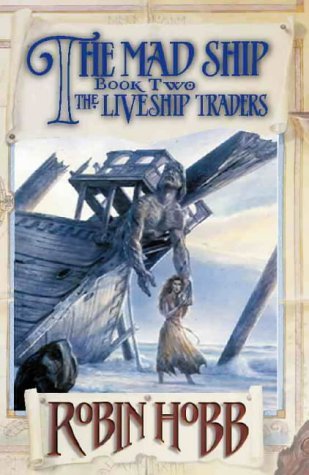
This book feels like being gently taken by the hand by Robin Hobb and starting a nice, leisurely hike through beautiful forests and fields on a breathtaking, misty morning in the warm autumn sun; walking on medieval streets through medieval towns next to medieval castles, meeting fascinating people and animals along the way. There are always things happening at a distance and you don't really know what to make of it, but Hobb just walks with you and you don't worry too much and get to take everything in as if it is your first time seeing and experiencing the world around you.
And the hike stretches on and the sun climbs higher, and while it stays unhurried, you start to pay more attention to the happenings in the distance - they start to feel important and also a bit scary and unsettling - but Hobb keeps walking, slowly but steadily and with every step you're starting to understand you're on a long, winding path that’s more than it seems.
By the time the sun sets, you've climbed higher than you realised, and suddenly you're on top of a mountain. You look back at the trail you've taken and all the years you've experienced and as you turn around--Hobb pushes you off the edge and in that split second, everything clicks into place and you’re racing down the mountain as fast as a runaway wheel of cheese and everything happens at the same time and suddenly makes so much sense and when you finally reach the bottom of the mountain you feel completely wrecked but in a good way
🙂👍

This book is an experience one should enter blind. Piranesi will tell you everything you need to know.
Tell him I said hi, please.

In her haunting, movingly lyrical, and raw memoir, “In the Dream House”, author Machado recounts living in and surviving an abusive queer relationship. By frequently addressing her past self (and in a way, the reader) as "you", she creates an incredibly intimate experience. The storytelling is fragmented—like looking into the past through a broken mirror, shattered to shield oneself from the pain—, each memory recounted in a different narrative style. It is very clear how much thought and care Machado put into writing this memoir; for example, she does not merely recount her own experiences, but looks beyond them and examines how abusive relationships between women were (and are) a puzzling phenomenon for a world in which a woman can only be a victim.
I listened to the audiobook and while the breathy way in which Machado talks (she narrates the book herself) wasn't my absolute favourite in the beginning, I still highly recommend it. Her voice has been narrating my inner monologue since I finished the book; that's how enchanting her tone and distinctive style is.

Livonia Chow Mein
Abigail Savitch-Lew
Pulling her shirt collar over her mouth and nose, Lina sucked in her breath and ran into 80 Livonia. Ducking as disintegrating tiles rained on her head, she raced up a staircase she could see only two steps at a time. [...] eyes burning, [...] she pushed through the smoke.
Okay, I know this is a novel and not real life but I feel obligated to chime in and say: please, please do not do this. Not only is it super dangerous, it also doesn't work in real life. Don't believe the action movies, soap operas and heroine stories. It will kill you. In many ways but mainly in one. Let me elaborate:
• No. 1: the smoke It's described as so thick that Lina can't even see past two steps at a time. That means it's hella thick, "doesn't get much worse than this"-bad. It's also described as "hot black smoke". Whenever you see black or even gray smoke, you're witnessing a so-called incomplete combustion process. A fire needs a few elemental things to burn like it wants to and if one of these things is missing, fire takes revenge by producing carbon monoxide and soot, among other things, which makes the smoke dark. Basically every house fire is an incomplete combustion process because of the lack of oxygen (fire needs a loooot). Now that we know that, let's talk about how incredibly dangerous this smoke is. Not only is it hot and therefore bad for your lungs (which do not like to breathe scorching hot air), its component carbon monoxide is super deadly. You take two, maximum four breaths in close proximity to it and you almost instantly lose consciousness. And then you die, because it takes the place of oxygen in your bloodstream. It clings much better to your red blood cells than oxygen and makes it impossible for oxygen to reach your organs, who basically suffocate.
• No. 2: nothing to breathe There's no oxygen because the fire takes it all. This thing Lina does, pulling her shirt collar over her mouth, does literally nothing. It would be a little useful repelling the bigger smoke particles if she were in an area with low smoke concentrations, but she's not. She's literally running into a place where there's nothing for her to breathe.
• No. 3: the heat Lina describes that the ceiling crashes down on her. Even with american plastic houses™, which I think this house is not, you'll need a lot of heat for that to happen. Too much for a human to withstand, even under adrenaline. Human instinct is very hard to overcome and if your skin starts burning and bubbling from the heat, you normally run away (please do). Also, if the temperature in a space is very high, things start burning without technically touching a flame. Every material has a certain temperature point where that happens, it's called a flash point. Lina would literally catch fire at one point or another.
(little detour: this is why newer homes tend to burn faster and hotter, because less solid furniture is used which has a very high flash point so it burns much later)
Conclusion: Lina is described running up to the third floor. Through thick smoke. With the ceiling coming down on her. Not only would she be dead in seconds from the smoke and burned to a crisp a few minutes later - if she somehow managed to survive all that, she'd get terribly, terribly lost. Even if you know the place: if you can't see and everything is falling apart, you will get lost. That's how firefighters die too - they lose orientation and run out of air.
Thank you for coming to my ted talk PB post 🙂↕️

Fahrenheit 451
Ray Bradbury
“Classics cut to fit fifteen-minute radio shows, then cut again to fill a two-minute book column, winding up at last as a ten- or twelve-line dictionary resume. I exaggerate, of course."
Oh, I am afraid you are not exaggerating 😶

The Complete Persepolis
Marjane Satrapi
The Germans sell chemical weapons to Iran and Iraq. The wounded are then sent to Germany to be treated. Veritable human guinea pigs.
This section caught my eye, and I wanted to dig a little deeper to see how involved Germany was in the 1. Gulf War (how the Iran-Iraq-war is sometimes called in Germany) and the export of chemical weapons.
Well. Colour me un-surprised when this turned out to be quite difficult and extremely unsettling. This is going to be quite a long post on my research (that is in no way conclusive, this is just a scraping of the surface).
Firstly, with the war currently going on it’s not easy to get the search engine to look into the past and then, to focus on the Iran-Iraq-War from 1980 to 1988 and not the 2. Gulf War one from 1990 to 1991. A lot of wars have similar names, and their names differ across languages.
Secondly, the sources I found on my first search were just vaguely related to the topic and focused specifically on the Halabja massacre from the 16th of March 1988. During this massacre, thousands of Kurds were killed in Halabja by chemical weapons and thousands were wounded. The attacker was later identified as the Iraqi government, under commandment by Saddam Hussein.
So, who supplied the Iraqi government with mustard gas, tabun and sarin (all deadly chemical weapons)? Eventually, I did find what I was looking for: articles in archives from popular German newspapers, hidden behind backlinks and backlinks, and even a document from the Bundeswehr (the German army) themselves. I was really surprised: the Bundeswehr talks about Germany supplying a war criminal with weapons of mass destruction?
Well, because it wasn’t technically Germany as in the German government but German companies that delivered materials for building chemical weapons facilities in Samarra and Falludscha (Iraqi cities). How? By saying that they were supplying materials to develop “pesticides for the date harvest”.
Back then, under German law, export was allowed “no questions asked” (except for weapons, sensitive electronics, nuclear and chemical technology, which needed special approval – but apparently, this approval was handed out quite easily, because “in case of doubt, the principle of freedom should prevail”). But no one can tell me that the government didn’t know what was going on, they simply had to.
And turns out, they did! In 1984, the government received information (from the CIA, of all players) that the material for the chemical weapons facilities was bought from German companies. But apparently, no one did anything with that information; the market was more important. Between 1981 and 1990, the government allowed the export of weapons and material to Iraq, worth over 1.3 billion DM (roughly 760 million Dollar). The laws were eventually sharpened step by step but that changed literally nothing. One of the companies was even stopped from exporting but they sued and won. So they got to export even more of the materials.
I think it’s important to note that during that time (1986), Germany (to be precise, West-Germany) was the largest exporter worldwide, bigger than the US and Japan. The focus was – surprise – on the arms sector, because it’s highly supported by the government and promises therefore long-term profit. It seems to me like there was a race to be won – by any means.
I found it mortifying to read how in some articles, the companies were portrayed as sleezy masterminds who managed to “trick” the government, while in a few others, these companies (yes, some still exist!) say that they were obeying the law and therefore, didn’t do anything wrong.
The companies did have to answer in court for their actions eventually, but only due to the disregard of the “Außenwirtschaftsgesetz” (Foreign Trade and Payments Act) and not for aiding and abetting genocide, war crimes or crimes against humanity. Reading articles from that time and how slowwww the investigations were going was btw one of the most frustrating things I’ve ever witnessed. The reason why they weren’t convicted for aiding genocide? Experts couldn’t decide if the materials that the German companies exported were exclusively for the production of poison gas – or also for pesticides. It was only in 2018, that survivors of the Halabja massacre sued the German companies for exactly these crimes. The lawsuit seems to still be going; the newest information on it, that I could find, was from 2024.
[Sidenote: In 2005 in the Netherlands, a Dutch businessman was convicted for aiding and abetting war crimes because he exported thousands of tons of chemicals to Iraq for the production of chemical weapons. He got 17 years and got out in 2015. He also used the same excuse the German companies used; he didn't know what the chemicals were used for and also, "an ammunition manufacturer is also not responsible if a murder is committed with it." (quote by the guy)]
I couldn’t find anything about German companies supplying Iran with chemical weapons though. However, they definitely treated wounded soldiers in German hospitals.
There’s so much more to this whole topic but it’s literally a never-ending rabbit hole. I’m heartbroken, not surprised and because of that, even more heartbroken. What a shitshow.



© 2025 Pagebound